
Particle Physics Simulation and K* Reconstruction
Overview
This project can be explored at the following link.
This project implements a Monte Carlo simulation of particle physics events using ROOT for statistical analysis and visualization.
The main goal is:
Reconstruct the K* resonance (mass ~0.892 GeV) from the invariant-mass spectrum of $\pi$-K pairs.
The code simulates events with light particles ($\pi$, K, p) and an unstable resonance (K*) whitch decays into two particles. Then it analyzes the invariant-mass spectra to identify the resonance peak above the combinatorial background.
Project Structure
The project is split into three main components:
1 particle.cpp
Implements the Particle class, which represents a physical particle with:
- name
- momentum (px, py, pz)
- mass
- charge
- optional decay width (for resonances)
Main features
-
Relativistic energy calculation: \(E = \sqrt{p^2 + m^2}\)
-
Invariant mass calculation between two particles:
- Two-body decay (
Decay2Body) - Includes resonance width effects (Breit-Wigner simulated via Gaussian distribution)
- Isotropic generation of decay products
- Relativistic boost to the laboratory frame
This class is the physics core of the project.
2 main.cpp
It is the simulation engine.
What it does
Defines particle types:
- $\pi^+$, $\pi^-$
- $K^+$, $K^-$
- $p^+$, $p^-$
- K* resonance (mass 0.89166 GeV, width 0.050 GeV)
Simulates 100,000 events with 100 particles each.
Particle Generation
Particles are generated with the following probabilities:
| Particle | Probability |
|---|---|
| $\pi^+$ | 40% |
| $\pi^-$ | 40% |
| $K^+$ | 5% |
| $K^-$ | 5% |
| $p^+$ | 4.5% |
| $p^-$ | 4.5% |
| K* | 1% |
The magnitude of the momentum follows an isotropic exponential distribution:
\[p \sim e^{-p}\]K* Production and Decay
When a resonance is generated:
- A particle
"resonance"is created - It decays into:
- $\pi^+ K^-$ (50%)
- $\pi^- K^+$ (50%)
- The following are recorded:
- invariant mass of decay products
- contribution to the combinatorial background
This is essential to verify that the resonance peak can be reconstructed even in the presence of background.
Analysis (analyse.cpp)
The analysis phase reads the generated ROOT file and checks the physical and statistical consistency of the simulation.
Consistency Checks
- Total number of particles generated
- Species distributions ($\pi$, K, p, K*)
- Comparison with theoretical probabilities (compatibility within $3\sigma$)
The goal is to verify that the Monte Carlo generation correctly reproduces the fractions set in the generator.
Distribution Studies
Several kinematic observables are analyzed:
- Uniform angle distributions ($\phi$, $\theta$)
- Exponential fit of the momentum magnitude:
- Invariant mass spectra built for:
- all pairs
- same-charge pairs
- opposite-charge pairs
- $\pi$-K pairs only
Combinatorial Background Subtraction
To isolate the K* signal, the difference between opposite-charge and same-charge pairs is used:
\[\text{Signal}(m) = \left( \frac{dN}{dm} \right)_{\text{opposite charge}} - \left( \frac{dN}{dm} \right)_{\text{same charge}}\]This method reduces the uncorrelated background, allowing the contribution of real resonances to emerge.
Two spectra are obtained:
- Full spectrum (all combinations)
- Spectrum selecting only $\pi$-K pairs
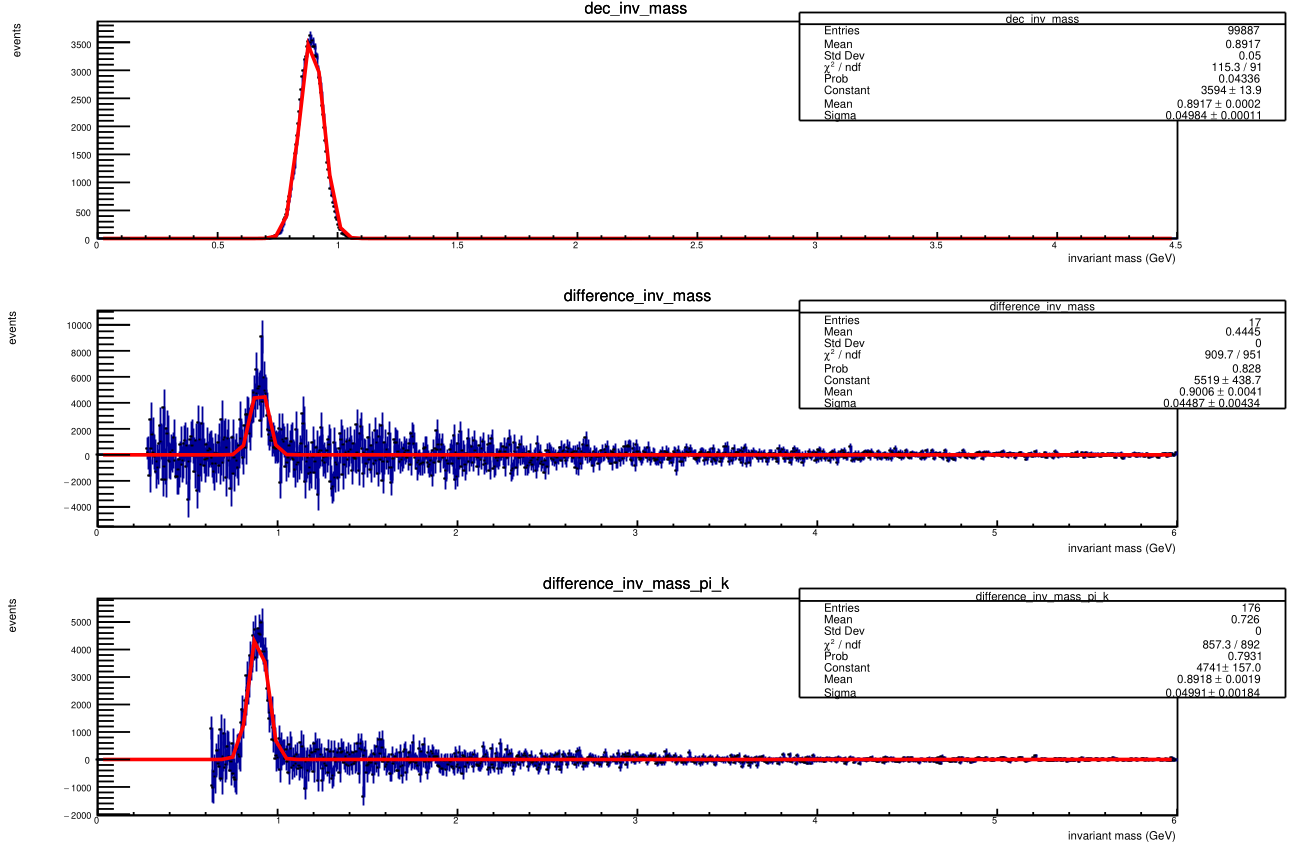
After removing the background, the graph of the invariant mass, visible below, show clearly a pcik in correspondence of the resonance mass k*.
Resonance Fit
The peak is fitted with a Gaussian function:
\[f(m) = A \exp\left( -\frac{(m - \mu)^2}{2\sigma^2} \right)\]The fit extracts:
- K* mass ($\mu$)
- Observed width ($\sigma$)
- $\chi^2/\text{NDF}$
- Fit probability
The expected result is a mass compatible with:
\[m_{K^*} \approx 0.892 \ \text{GeV}\]Why This Project Is Interesting
This code reproduces, in simplified form, real analysis techniques used in high-energy physics:
- Resonance reconstruction via invariant mass
- Combinatorial background estimation and subtraction
- Statistical fits with ROOT
- Validation through $\chi^2$ and fit probability
To do this, it goes through all phases of a simulation. It starts with the physical part of the project where particles are generated according to a given distribution and the decay of possible K* is studied. Thanks to the data analysis phase different histograms of possible combinations are built and the background is then removed. This process highlights a peak in the invariant-mass plot, revealing the presence of the resonance. This small-scale model allow to understand in a simplified way a possible process used to discover new particles.
👥 Collaborators
This project was possible thanks to the contributions of: